The first ascent of Kilimanjaro
Hans Meyer · 1889 CE · Earth
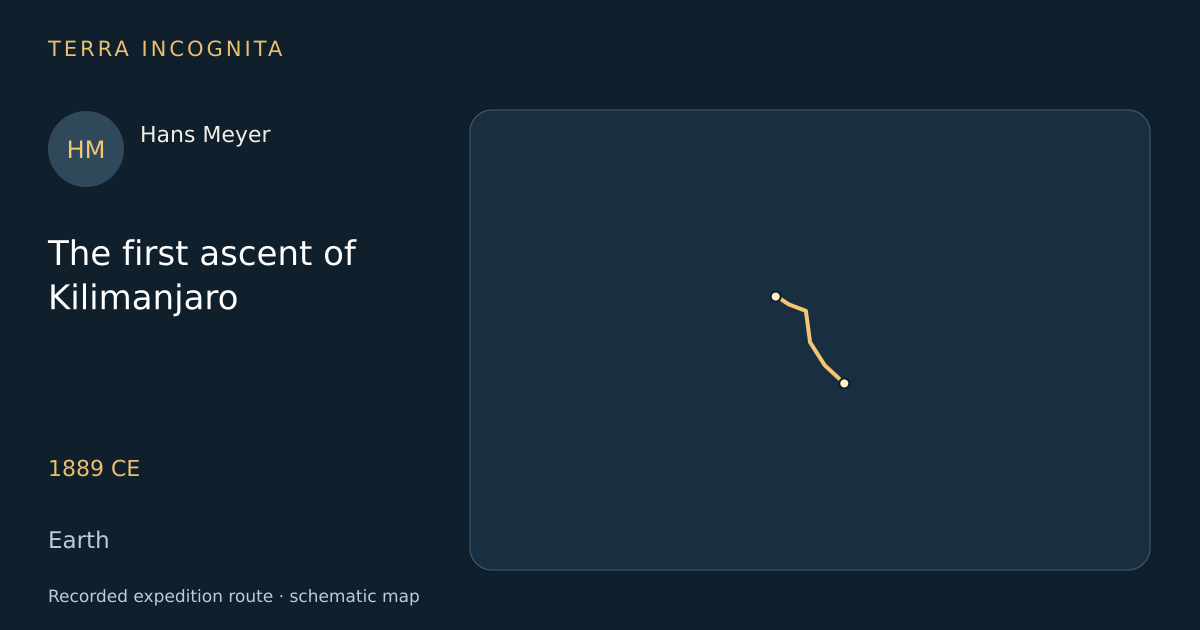
Reach the highest point of Kibo across the ice cap that had stopped every earlier attempt, and map the summit.
Historical context
When the missionary Johannes Rebmann reported snow on the equator in 1848, geographers in London refused to believe him. Forty years later the mountain lay in the new German colony of East Africa, and a Leipzig publisher's son, Hans Meyer, made it his object: turned back by the ice in 1887, taken hostage and ransomed in the coastal revolt of 1888, he came back in 1889 with the Austrian climber Ludwig Purtscheller, a young Chagga guide named Lauwo, and enough porters to put a chain of camps up the mountain.
The voyage, step by step
Chief Mareale's Marangu
27 September 1889
From the Chagga state of Marangu, on Kilimanjaro's southern slopes, Meyer sets out on 27 September 1889 with Ludwig Purtscheller, the young guide Yohani Kinyala Lauwo, two headmen, nine porters and a cook. The young chief Mareale visits the camp every day and rarely leaves without taking something away.
Abbott camp on the moor
29 September 1889
Above the forest the caravan makes its first standing camp at 3,894 metres, named after the American naturalist Abbott who had tried the mountain before them. Above it lies the bare saddle between Kibo and the jagged Mawenzi.
Kibo camp and the diet
2 October 1889
At the Kibo camp on the saddle, 4,263 metres, the climbers face the ice with dried meat, cold rice and citric acid, and no appetite for any of it. Meyer contrasts it with starting from an Alpine hotel with bread, ham, eggs and wine.
Twenty strokes a step
3 October 1889
On 3 October, at half past ten, they begin cutting steps up an ice wall as hard as glass, each step costing some twenty strokes of the axe, and reach the foot of the last precipice at half past twelve. Towards two o'clock the secret of Kibo lies at their feet: a gigantic crater with precipitous walls.
The hollow in the rocks
5 October 1889
On 5 October they move camp higher, to a hollow in the rocks at 15,260 feet, about the height of Monte Rosa, which Mwini lines with armfuls of everlasting flowers. At three in the morning of the 6th they wake at ten degrees Fahrenheit and set off by moonlight and lantern.
Kaiser Wilhelm's Peak
6 October 1889
By the steps of three days before they cross the great crevasse at eight, reach the rim at a quarter to nine, and after an hour and a half along the crater's edge climb three rocky pinnacles of loose blocks; at half past ten Meyer is first on the middle one, 19,700 feet by his aneroid. He plants a small German flag with three cheers and names the peak Kaiser Wilhelm's Peak.
Into the crater, and Mawenzi
18 October 1889
On 18 October they climb Kibo again to enter and study the crater, cresting the rim at the notch that now bears Meyer's name, then attempt Mawenzi and reach only a subsidiary point before illness turns them back. Kibo is not climbed again for twenty years.
Outcome
The crater rim on 3 October and the summit on 6 October 1889 at half past ten, named Kaiser Wilhelm's Peak; a second entry into the crater on 18 October, and an attempt on Mawenzi.
Hans Meyer
A Leipzig geographer who, on his third attempt and with the Austrian Ludwig Purtscheller, cut his way up the ice cap of Kibo to the highest point of Africa on 6 October 1889.
Sources
- Hans Meyer (geographer) — Wikipedia
- Mount Kilimanjaro — Wikipedia
- Across East African Glaciers: An Account of the First Ascent of KilimanjaroHans Meyer, translated by E. H. S. Calder · George Philip and Son · 1891
- Who was the first person to climb Mount Kilimanjaro?Altezza Travel
Continue exploring
- The FitzGerald expedition to AconcaguaMatthias Zurbriggen · 1896 CE – 1897 CE
- The Mackinder expedition to Mount KenyaHalford Mackinder · 1899 CE
- Lucy Walker on the MatterhornLucy Walker · 1871 CE
- The first ascent of the MatterhornEdward Whymper · 1865 CE