Curiosity traverse in Gale crater
Curiosity · 2012 CE – 2026 CE · Mars
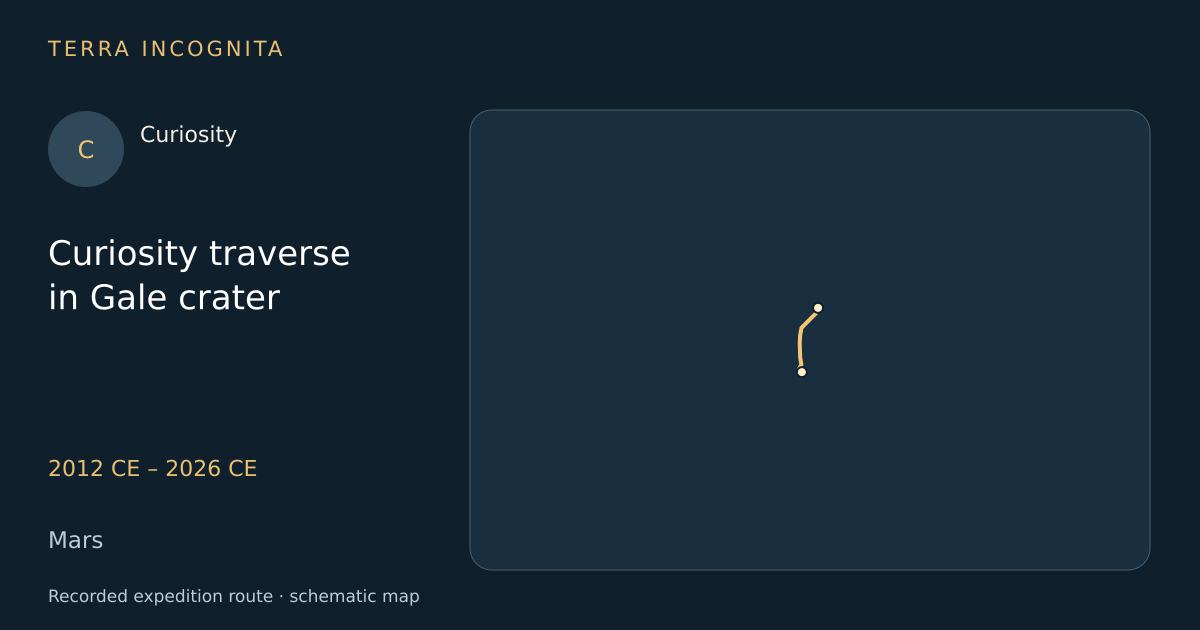
Find out whether Gale crater was ever able to support life, and read its layered mountain.
Historical context
By 2012 the question was no longer whether Mars had water but whether any of that water had been habitable. Curiosity was built as a laboratory on wheels and landed in a crater whose central mountain stacks the sediments of hundreds of millions of years. It answered the question at Yellowknife Bay within eight months, and has spent the years since reading the drying of a world.
The voyage, step by step
Seven minutes of terror
6 August 2012
On 6 August 2012 a rocket-powered crane lowered the rover on nylon cables, cut them and flew off to crash 650 m away.
A first scoop of sand
2012 CE
At a small drift of dust and sand the rover scooped, sieved and baked its first samples, and rinsed its own handling system clean.
Yellowknife Bay
February 2013
A grey mudstone drilled in February 2013 yielded clay, sulphur, nitrogen, phosphorus, oxygen and carbon: the chemistry of a habitable lake.
The Kimberley
2014 CE
Sandstone beds tilted towards the mountain showed a river delta building out into the ancient lake.
The foot of the mountain
2014 CE
At Pahrump Hills the rover reached the base of Mount Sharp itself and began the climb it had been sent to make.
Murray Buttes
2016 CE
The rover threaded between mesas and buttes of wind-carved sandstone, the fossilised dunes of a desert that followed the lake.
Vera Rubin ridge
2018 CE
A hard ridge rich in haematite resisted the drill for months before the rover was taught to bore with a new percussive technique.
Gediz Vallis ridge
2023 CE
High on the mountain the rover reached a ridge of boulders and gravel dumped by debris flows long after the lake had gone.
Outcome
A habitable freshwater lake proved at Yellowknife Bay, and a climb of hundreds of metres up Mount Sharp.
Curiosity
Nuclear-powered laboratory rover that has been reading the layers of Mount Sharp in Gale crater since August 2012.
Sources
- Curiosity (rover) — Wikipedia
- A Habitable Fluvio-Lacustrine Environment at Yellowknife Bay, Gale Crater, MarsJohn P. Grotzinger et al. · Science, vol. 343 · 2014
- NASA Jet Propulsion Laboratory — Mars mission pagesNASA / JPL-Caltech
Continue exploring
- Phoenix at the northern plainsPhoenix · 2008 CE
- InSight station in Elysium PlanitiaInSight · 2018 CE – 2022 CE
- Opportunity traverse on Meridiani PlanumOpportunity · 2004 CE – 2018 CE
- Spirit traverse in Gusev craterSpirit · 2004 CE – 2010 CE