Chang'e 4 far-side landing
Chang'e 4 · 2018 CE – 2019 CE · The Moon
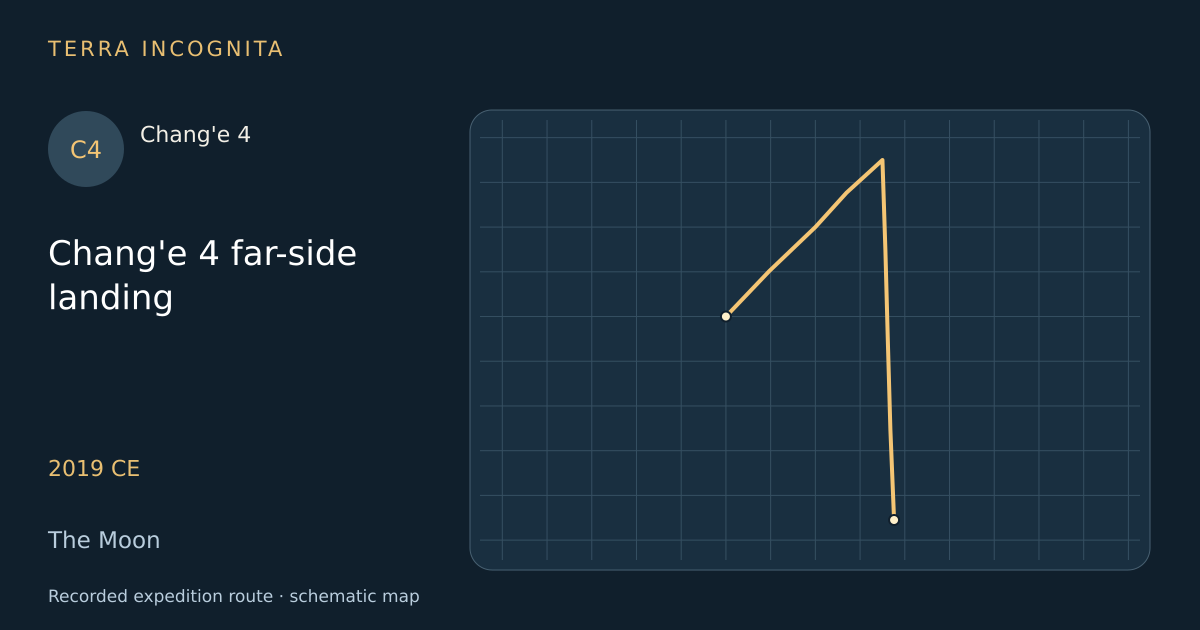
Land on the far side of the Moon, in the South Pole–Aitken basin, and explore it with a rover, talking to Earth through the Queqiao relay satellite.
Historical context
Because the far side never faces Earth, the China National Space Administration first stationed a relay satellite, Queqiao, beyond the Moon in 2018. Chang'e 4, built as the backup of Chang'e 3, then landed in Von Kármán crater on 3 January 2019: by China's announcement, the first spacecraft to soft-land on the far side, which Luna 3 had photographed in 1959 and Ranger 4 had struck in 1962.
The voyage, step by step
A bridge of magpies
7 December 2018
At 18:23 UTC on 7 December 2018, 02:23 on 8 December in Beijing, a Long March 3B lifts Chang'e 4 off from Xichang; a relay satellite launched in May already waits beyond the Moon.
Behind the Moon
3 January 2019
On 3 January 2019, at 10:15 Beijing time, controllers send the order and Chang'e 4 fires its engine fifteen kilometres above the far side, with no one able to watch it directly.
Into the oldest scar
2019 CE
The target lies inside the South Pole–Aitken basin, a hole about 2,500 kilometres wide that the physicist Andrew Coates called the largest, deepest and oldest basin on the Moon.
Touchdown on the far side
3 January 2019
At 10:26 Beijing time, 02:26 UTC, the lander settles on the floor of Von Kármán crater; CNSA announces the first soft landing on the Moon's far side.
Yutu-2 rolls off
3 January 2019
At 22:22 Beijing time, 14:22 UTC, about twelve hours after the landing, the six-wheeled rover Yutu-2 rolls down its ramps onto the far side.
A seed that sprouted
2019 CE
Inside a sealed canister on the lander, a cotton seed puts out a shoot, in what Andrew Jones called the first test of plant growth in the environment of the Moon.
Outcome
Landed in Von Kármán crater on 3 January 2019, by CNSA's announcement the first soft landing on the far side; the rover Yutu-2, built for three months, later passed Lunokhod 1's longevity record and had driven 1,613 metres by September 2024.
Chang'e 4
Chinese lander and rover that made, by CNSA's announcement, the first soft landing on the far side of the Moon, on 3 January 2019.
Sources
- Chang'e 4 — NSSDCA Master Catalog (Wayback Machine copy of 10 August 2025)NASA Space Science Data Coordinated Archive
- Xinhua Headlines: China launches relay satellite to explore Moon's far sideXinhua · Xinhua News Agency (Chinese state news agency) · 2018
- How China's lunar relay satellite arrived in its final orbitLuyuan Xu · The Planetary Society · 2018
- China launches historic mission to land on far side of the moonStephen Clark · Spaceflight Now · 2018
- China's Chang'e-4 probe decelerates near moonXinhua · Xinhua News Agency (Chinese state news agency) · 2018
- China's Chang'e-4 probe changes orbit to prepare for moon-landingXinhua · Xinhua News Agency (Chinese state news agency) · 2018
- How the Chang'e-4 spacecraft will land on the far side of the MoonAndrew Jones · gbtimes · 2018
- China successfully lands Chang'e-4 on far side of MoonJason Davis · The Planetary Society · 2019
- China's Chang'e-4 probe makes historic landing on moon's far side (Xinhua report)Xinhua · China National Space Administration · 2019
- Descent trajectory reconstruction and landing site positioning of Chang'E-4 on the lunar farside, Nature Communications 10, 4229Jianjun Liu, Xin Ren, Wei Yan, Chunlai Li et al. · Nature Communications · 2019
- Chang'e-4 spacecraft enter lunar nighttime, China planning future missions, cooperationAndrew Jones · SpaceNews · 2019
- Plane Speaking with Dr Wu Weiren (Wayback Machine copy)Royal Aeronautical Society, AEROSPACE · 2019
- Chang'E-4 initial spectroscopic identification of lunar far-side mantle-derived materials, Nature 569 (abstract)Chunlai Li, Dawei Liu, Bin Liu et al. · Nature · 2019
- Von Kármán Crater: Awaiting A VisitorMark Robinson · Lunar Reconnaissance Orbiter Camera, Arizona State University · 2019
- Chang'e 4 Lander CoordinatesMark Robinson · Lunar Reconnaissance Orbiter Camera, Arizona State University · 2019
- Chang'e 4 Rover Comes into ViewMark Robinson · Lunar Reconnaissance Orbiter Camera, Arizona State University · 2019
- Above the Landing SiteMark Robinson · Lunar Reconnaissance Orbiter Camera, Arizona State University · 2019
- Hsue-Shen Tsien — Mathematics Genealogy ProjectMathematics Genealogy Project, North Dakota State University
- Chang'e-4: Chinese rover now exploring MoonPaul Rincon · BBC News · 2019
- Chang'e 4: China probe lands on far side of the moonThe Guardian · 2019
- The Moon's farside shallow subsurface structure unveiled by Chang'E-4 Lunar Penetrating Radar, Science Advances 6, eaay6898Chunlai Li, Yan Su, Elena Pettinelli et al. · Science Advances · 2020
- Statio Tianhe, Zhinyu, Hegu, Tianjin and Mons Tai — Gazetteer of Planetary NomenclatureIAU Working Group for Planetary System Nomenclature / USGS
- Lunar nighttime brings end to Chang'e-4 biosphere experiment and cotton sproutsAndrew Jones · gbtimes · 2019
- Chinese lunar lander's cotton seeds spring to life on far side of the moonWilliam Zheng · South China Morning Post · 2019
- China's Farside Moon Rover Breaks Lunar Longevity RecordLeonard David · Space.com · 2019
- Moon 'mystery hut' is just a rabbit-shaped rock, Chinese rover findsAndrew Jones · Space.com · 2022
- China's Yutu 2 rover reveals deep layers below far side of the moonAndrew Jones · Space.com · 2023
- Yutu-2 rover likely immobile on the moon after historic lunar far side missionAndrew Jones · SpaceNews · 2025
- Chang'e 4 — Wikipedia
Continue exploring
- Chandrayaan-3 landingChandrayaan-3 · 2023 CE
- Apollo 17 landingApollo 17 · 1972 CE
- Luna 16 sample returnLuna 16 · 1970 CE
- Lunokhod 1 traverseLunokhod 1 · 1970 CE – 1971 CE