Apollo 8 lunar orbit
Apollo 8 · 1968 CE · The Moon
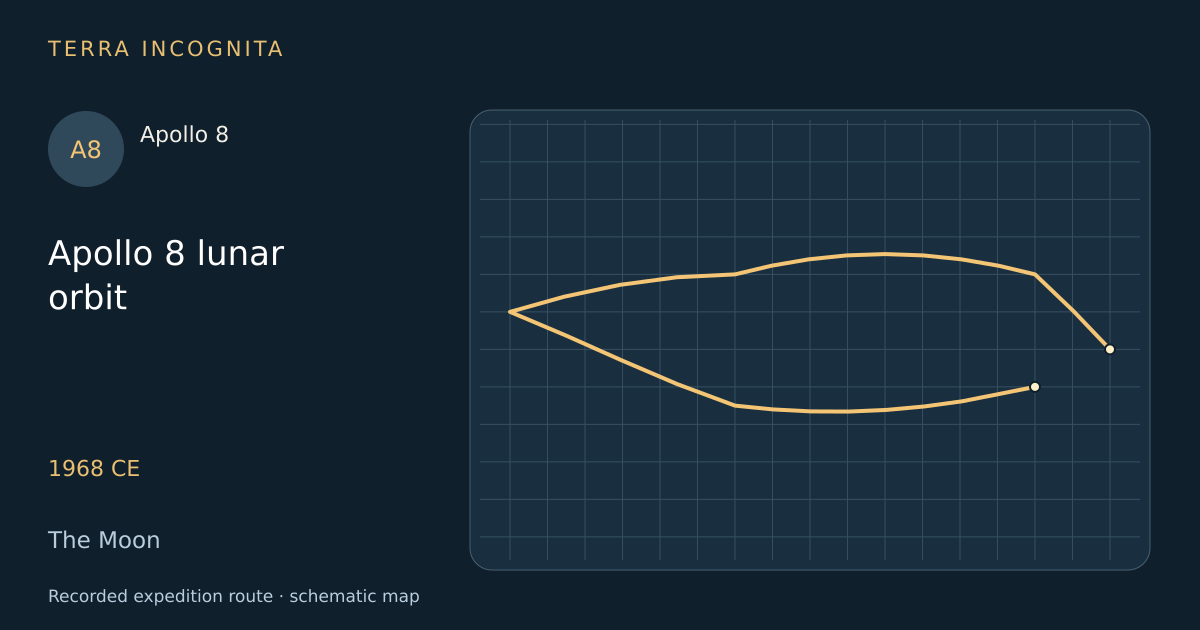
Fly the command and service modules, without a lunar module, into orbit around the Moon and back: the first crewed flight to the Moon.
Historical context
In August 1968, with the lunar module running late, NASA's Apollo managers began preparing in secret to send the next Saturn V's crew into orbit around the Moon that December, on the rocket's first crewed flight; the lunar orbit was approved in November. Frank Borman, Jim Lovell and Bill Anders became the first people to fly to the Moon and see its far side with their own eyes, and Anders's photograph of the Earth rising over the Moon became what the photographer Galen Rowell called the most influential environmental photograph ever taken.
The voyage, step by step
Leaving Earth
21 December 1968
At 12:51 UTC on 21 December 1968, 07:51 Eastern Standard Time, the first Saturn V to carry a crew lifts Frank Borman, Jim Lovell and Bill Anders off Launch Complex 39A at the Kennedy Space Center, bound for lunar orbit.
“You are Go for TLI”
21 December 1968
At 15:41 UTC on 21 December, 10:41 Eastern Standard Time, after a revolution and a half of Earth orbit, the third stage fires again for five minutes and nineteen seconds and sends Apollo 8 out of Earth orbit toward the Moon.
Orbiting the Moon
24 December 1968
At 09:59 UTC on 24 December, 03:59 Central Standard Time in Houston, the service module's engine fires for about four minutes over the far side, out of contact, and puts Apollo 8 into lunar orbit; it will circle the Moon ten times in twenty hours.
Behind the Moon
24 December 1968
For some forty-six minutes of every two-hour orbit the crew is out of contact behind the Moon. On the fourth revolution, at about 16:38 UTC on 24 December, 10:38 in Houston, Anders sees the Earth coming up over the lunar horizon.
Christmas Eve broadcast
25 December 1968
At 02:34 UTC on 25 December, 20:34 on Christmas Eve in Houston, Apollo 8 comes out from behind the Moon on its ninth revolution, televising live; twenty-four minutes later, nearing the Sea of Tranquility at sunrise, the crew reads the opening of Genesis.
Bringing Earthrise home
25 December 1968
Behind the Moon on Christmas morning, at 06:10 UTC on 25 December, the engine fires to send Apollo 8 home. The command module splashes down in the Pacific in darkness at 15:51 UTC on 27 December, with Anders's Earthrise photographs aboard.
Outcome
Ten revolutions of the Moon in twenty hours on 24 and 25 December 1968, the first photographs of Earthrise taken by people, a Christmas Eve reading from Genesis, and splashdown in the Pacific on 27 December.
Apollo 8
First crewed mission to orbit the Moon, whose photographs of Earthrise changed how humanity saw its planet.
Sources
- Chariots for Apollo: A History of Manned Lunar Spacecraft (NASA SP-4205), chapter 11.2: Proposal for a Lunar Orbit MissionCourtney G. Brooks, James M. Grimwood and Loyd S. Swenson Jr. · NASA History Office (Wayback Machine copy of 23 July 2010) · 1979
- Chariots for Apollo: A History of Manned Lunar Spacecraft (NASA SP-4205), chapter 11.5: The Apollo 8 DecisionCourtney G. Brooks, James M. Grimwood and Loyd S. Swenson Jr. · NASA History Office (Wayback Machine copy of 23 July 2010) · 1979
- Chariots for Apollo: A History of Manned Lunar Spacecraft (NASA SP-4205), chapter 11.6: Apollo 8: The First Lunar VoyageCourtney G. Brooks, James M. Grimwood and Loyd S. Swenson Jr. · NASA History Office (Wayback Machine copy of 27 October 2020) · 1979
- Apollo 8 Mission Report (MSC-PA-R-69-1)Mission Evaluation Team, NASA Manned Spacecraft Center · NASA Manned Spacecraft Center, Houston · 1969
- Apollo 8, Day 1: Earth Orbit and Translunar Injection — Apollo Flight JournalW. David Woods, Frank O'Brien and William Smeaton, editors · Apollo Flight Journal · 2002
- Apollo 8, Day 3: The Black Team, Approaching the Moon — Apollo Flight JournalW. David Woods, Frank O'Brien and William Smeaton, editors · Apollo Flight Journal · 2003
- Apollo 8, Day 3: Lunar Encounter — Apollo Flight JournalW. David Woods, Frank O'Brien and William Smeaton, editors · Apollo Flight Journal · 2003
- Apollo 8, Day 4: Lunar Orbit 1 — Apollo Flight JournalW. David Woods, Frank O'Brien and William Smeaton, editors · Apollo Flight Journal · 2003
- Apollo 8, Day 4: Lunar Orbit 2 — Apollo Flight JournalW. David Woods, Frank O'Brien and William Smeaton, editors · Apollo Flight Journal · 2003
- Apollo 8, Day 4: Lunar Orbit 3 — Apollo Flight JournalW. David Woods, Frank O'Brien and William Smeaton, editors · Apollo Flight Journal · 2003
- Apollo 8, Day 4: Lunar Orbit 4 — Apollo Flight JournalW. David Woods, Frank O'Brien and William Smeaton, editors · Apollo Flight Journal · 2004
- Apollo 8, Day 4: Lunar Orbit 6 — Apollo Flight JournalW. David Woods, Frank O'Brien and William Smeaton, editors · Apollo Flight Journal · 2004
- Apollo 8, Day 4: Lunar Orbit 9 — Apollo Flight JournalW. David Woods, Frank O'Brien and William Smeaton, editors · Apollo Flight Journal · 2001
- Apollo 8, Day 4: Trans-Earth Injection — Apollo Flight JournalW. David Woods, Frank O'Brien and William Smeaton, editors · Apollo Flight Journal · 2004
- Apollo 8, Day 6: Re-entry and Splashdown — Apollo Flight JournalW. David Woods, Frank O'Brien and William Smeaton, editors · Apollo Flight Journal · 2004
- Earthrise: The 45th Anniversary (visualization 4129)Ernie Wright · NASA Goddard Space Flight Center, Scientific Visualization Studio · 2013
- Who Took the Legendary Earthrise Photo From Apollo 8?Andrew Chaikin · Smithsonian Magazine, January 2018 (Wayback Machine copy of 11 January 2018) · 2018
- Anders' Earthrise — Gazetteer of Planetary NomenclatureIAU Working Group for Planetary System Nomenclature · USGS Astrogeology Science Center · 2018
- Mount Marilyn — Gazetteer of Planetary NomenclatureIAU Working Group for Planetary System Nomenclature · USGS Astrogeology Science Center · 2017
- How Apollo 8 Delivered a Moment of Christmas Eve Peace and Understanding to the World (excerpt from Operation Moonglow)Teasel Muir-Harmony · Smithsonian Magazine, December 2020 (Wayback Machine copy of 11 December 2020) · 2020
- Telecasts from Apollo 8 — American ExperiencePBS American Experience · WGBH / PBS
- Memorandum Opinion, Madalyn Murray O'Hair et al. v. Thomas O. Paine et al. (A-69-CA-109), 1 December 1969Jack Roberts, U.S. District Judge · U.S. National Archives at Fort Worth, Record Group 21 (National Archives Identifier 40846500), via DocsTeach · 1969
- How Apollo 8 ‘Saved 1968’Alice George · Smithsonian Magazine, December 2018 (Wayback Machine copy of 11 December 2018) · 2018
- Remembering 1968: How Apollo 8 sent a timeless holiday greeting from the heavensLee Cowan, CBS News Sunday Morning · CBS News, 23 December 2018 · 2018
- Apollo 8 Astronauts Reflect on Historic Moon Voyage 50 Years LaterJeffrey Kluger · Time · 2018
- Beyond Earth: A Chronicle of Deep Space Exploration, 1958–2016 (NASA SP-2018-4041)Asif A. Siddiqi · NASA History Division · 2018
- Apollo 8 — Wikipedia
Continue exploring
- Apollo 11Neil Armstrong · 1969 CE
- Surveyor 3 landingSurveyor 3 · 1967 CE – 1969 CE
- Luna 16 sample returnLuna 16 · 1970 CE
- Luna 9 landingLuna 9 · 1966 CE